
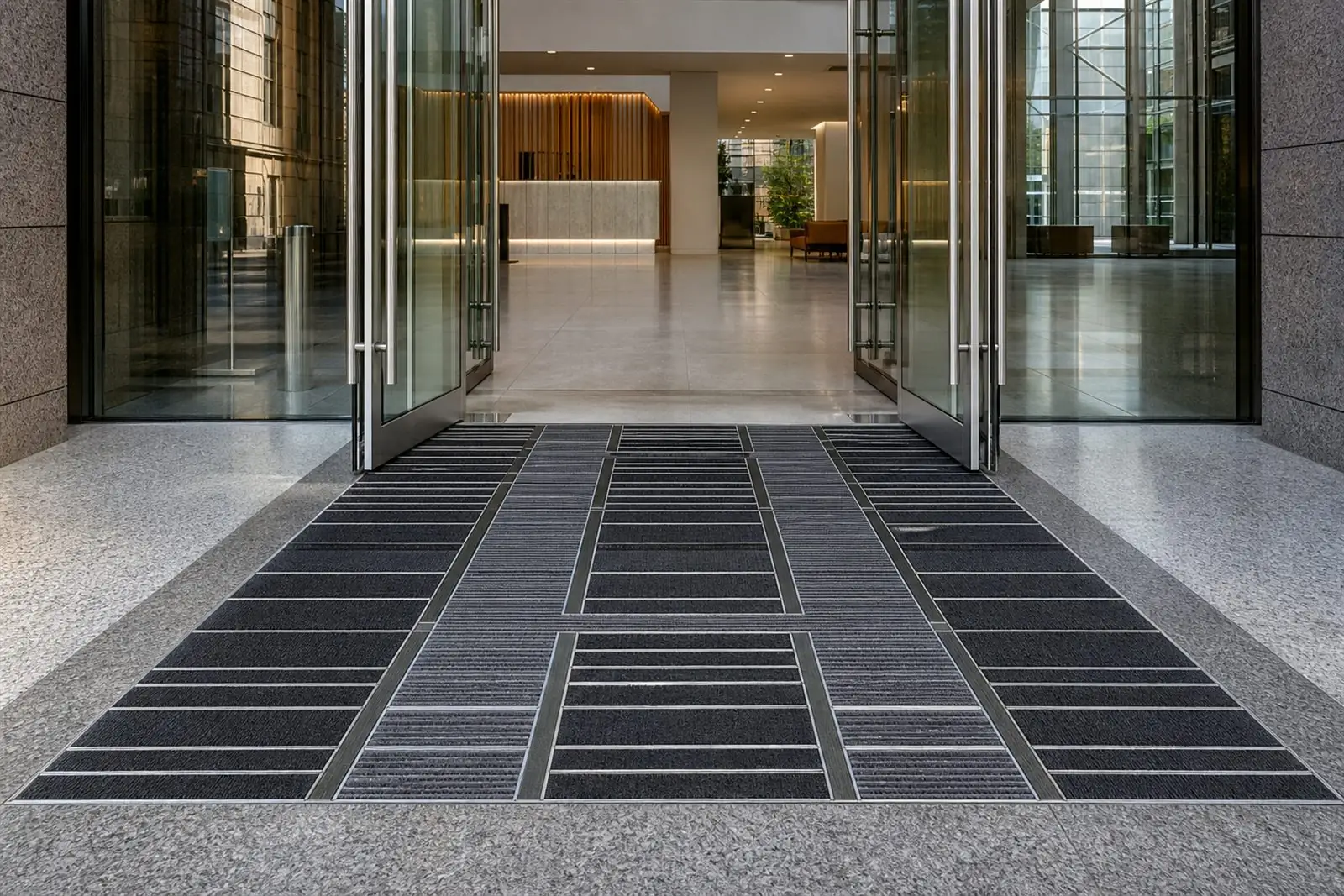
The few square metres inside your front door are the hardest-working flooring in the whole building. Every particle of grit, every wet footprint and every trolley wheel comes through them, and whatever they fail to stop gets ground into the expensive floor beyond. Yet entrance matting is routinely the last thing specified and the first thing value-engineered out. This guide covers how a proper entrance system works, the options at each price point, and how to size one honestly.
Think in zones, not in doormats
A commercial entrance works as a system of zones, each doing a different job.
- Zone 1 sits outside or in the door recess and does the coarse work: scraping mud, grit and heavy soil off shoes before they cross the threshold. Ribbed rubber, aluminium scraper profiles and open-construction mats that let debris fall through all belong here.
- Zone 2 is the primary barrier just inside the door, usually a recessed system that combines scraping strips with absorbent textile inserts, taking off the finer soil and most of the moisture.
- Zone 3 is the circulation area beyond, where heavy-duty textile walk-off tiles or rolls deal with the last of the damp and protect the main floor finish as traffic spreads out.
Small entrances can merge zones, but the principle holds everywhere: the more paces someone takes over matting before reaching the main floor, the less soil and water gets carried in. A single mat that both feet only strike once is decoration, not protection.
Matwell or surface-mounted
Recessed matting sits in a matwell, a shallow tray built into the screed so the mat finishes perfectly flush with the surrounding floor. It is the cleanest look, the safest threshold and the right answer whenever the floor build-up allows it, which is why we always ask about matwells early in a fit-out, while the levels can still be adjusted cheaply.
Where there is no well and no appetite to cut one, surface-mounted systems with tapered edge trims are the retrofit answer. Modern low-profile systems keep the height difference small, but edges need to be properly ramped and secured, and thresholds must stay manageable for wheelchairs, prams and trolleys. Level, firm access is an obligation under the Equality Act as well as good sense, and a curled or rucked entrance mat is one of the most common trip hazards in commercial buildings. BS 7953 is the British Standard covering the selection and installation of entrance flooring systems, and a specification that references it is a good sign you are being sold a system rather than a rug.
Choosing the construction
Aluminium-framed systems are the commercial benchmark for Zone 2: extruded profiles with replaceable inserts, in combinations of scraper strips for grit and textile strips for moisture. They roll up out of the well for cleaning, handle trolley and wheelchair traffic well, and individual inserts can be replaced as they wear rather than renewing the whole mat.
Heavy-duty textile walk-off tiles and rolls are the workhorses of Zone 3. Coarse, absorbent fibre construction built specifically to trap soil and hold water, in tile formats that swap out individually when the traffic lane wears. They look like carpet but perform very differently; standard carpet tile in an entrance clogs and flattens quickly.
Rubber and ribbed scraper matting covers Zone 1 and external use: simple, brutal and effective at getting the worst off footwear before the door.
Coir, the traditional natural fibre mat, still has a place in heritage buildings, though it needs a deeper well than modern systems, sheds fibre and crushes flat under heavy traffic. In most modern commercial entrances the aluminium-plus-textile combination outperforms it comfortably.
Sizing it honestly
Bigger is genuinely better with entrance matting, and undersizing is the most common specification mistake we see. Aim for a system deep enough in the direction of travel that each foot lands on matting more than once, cover the full width of the door opening plus the natural spread of traffic, and if the entrance serves a busy street frontage, extend Zone 3 further than feels generous on the plan. The cost per square metre of matting is small against the flooring, cleaning and slip liability it protects.
Maintenance is part of the system
Matting works by holding dirt and water, which means it fills up. A clogged mat stops protecting the building and starts feeding soil back onto shoes. Daily vacuuming in busy buildings, periodic deep cleaning of the inserts, and occasionally lifting roll-up systems to clear the well underneath keep the system doing its job. Specify replaceable-insert systems in busy entrances and worn strips can be renewed individually for years before the frame needs touching.
What good matting actually saves
Everything beyond the mat lasts longer: LVT, wood and carpet all wear on the grit that walks in on shoes, and manufacturers’ warranties generally assume adequate entrance protection is in place. Wet walk-off is the other half of the case, because water tracked onto a smooth lobby floor is the classic commercial slip claim. Add reduced daily cleaning of the main floor, and entrance matting is one of the few parts of a fit-out that quietly pays for itself.
Common questions
Do we need a recessed matwell, or will a surface mat do? If the floor build-up allows a well, use one: flush matting is safer, looks better and takes trolley and wheelchair traffic without edge damage. In a retrofit where cutting a well is impractical, a low-profile surface-mounted system with properly ramped edges is a sound second choice.
How big should the entrance matting be? Deep enough in the walking direction that both feet land on matting more than once, and the full width of the entrance. In high-traffic buildings, larger again. If in doubt, size up; undersized matting is the most common mistake in entrance specification.
Can you match matting to our brand or floor design? Yes. Textile inserts and walk-off tiles come in a wide range of colours, aluminium frames in different finishes, and logo inserts are available for reception entrances. The performance spec comes first, but there is plenty of room to make the entrance look intentional.
If you are planning an entrance for a new fit-out, or an existing lobby floor is wearing faster than it should, we supply and fit complete entrance matting systems across London, from matwell formation to the final insert. Get a free quote and we will usually come back within 48 hours.