
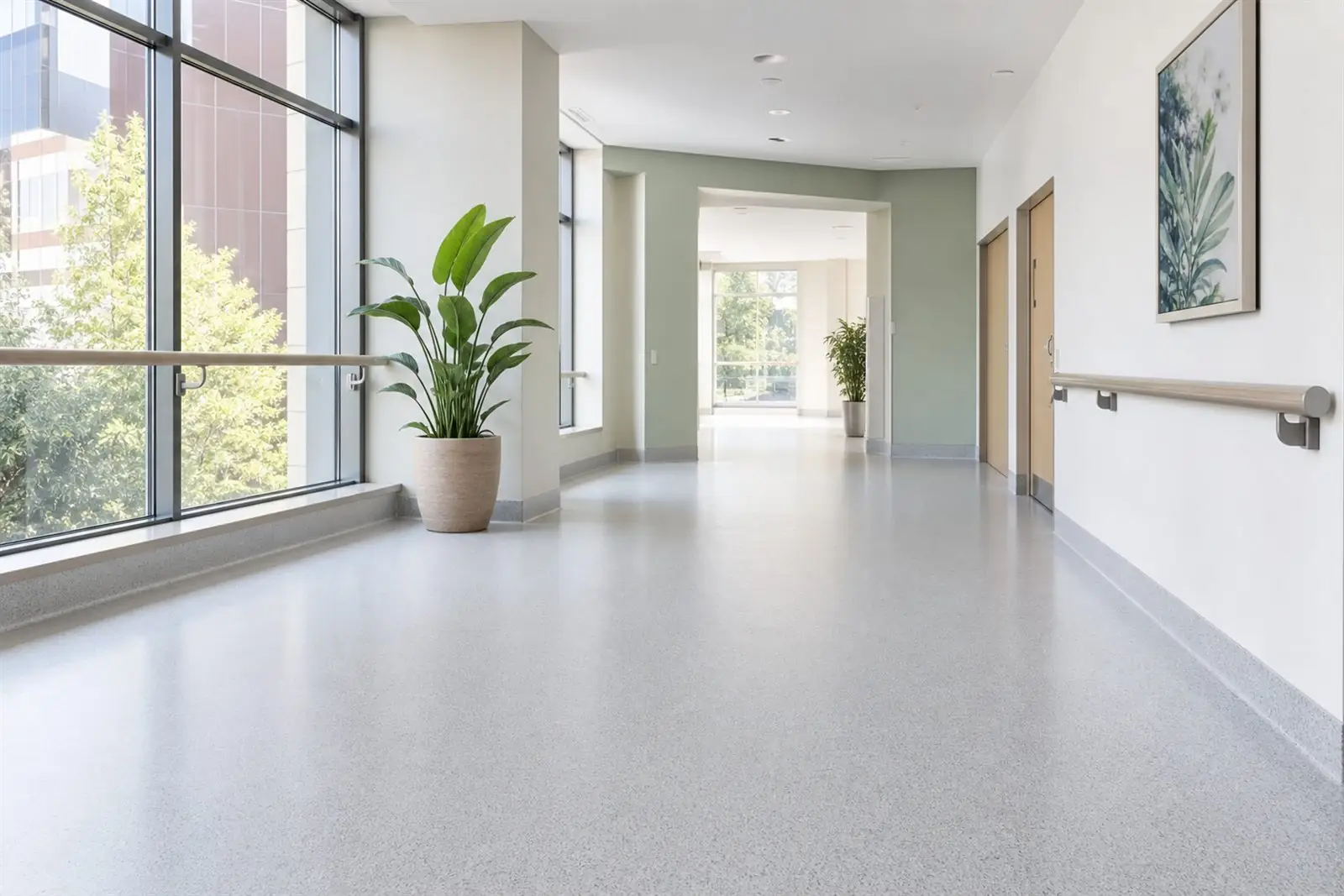
Slips and trips are one of the most common causes of injury in UK workplaces, and the floor is usually at the heart of it. A wet entrance, a greasy kitchen, a ramp that looked fine when it was dry: these are the spots where someone goes down. The good news is that slip resistance is measurable, and once you understand the numbers you can specify a floor that is genuinely safe rather than one that just looks the part. Here is how we read the ratings, and where each belongs.
Why slip resistance is not optional
The Health and Safety Executive (HSE) treats slips and trips as a serious, preventable risk, and they are consistently among the leading causes of major injury at work. That matters on two fronts: the obvious one, that someone gets hurt, and liability. If a floor is shown to be unsuitable for how it is used, and someone slips, the responsibility tends to land on whoever specified or maintained it.
So slip resistance is not a nice-to-have you bolt on at the end. It is part of the brief from the start, and one of the few flooring qualities you can actually put a number to.
The two numbers that matter: R ratings and PTV
There are two main ways slip resistance gets measured, and they are not the same thing.
R ratings come from the German DIN 51130 ramp test, where a tester walks an oil-covered sample on a ramp that tilts until they start to slip, and the angle gives the rating. It runs from R9 (least slip-resistant) up to R13 (most slip-resistant). Higher is grippier. R ratings are the figures you will see most often on a manufacturer’s data sheet, useful shorthand, but the test uses oil and a boot, which reflects an industrial or kitchen setting more than a barefoot or shod-but-dry one.
Pendulum Test Value (PTV) is the measure the HSE favours, partly because it can be done in the lab and on the installed floor. A weighted pendulum with a rubber slider swings across the surface and the drag is read off a scale. As a rough guide, a PTV of 36 or above is classed as low slip risk, the mid-20s to mid-30s is moderate, and below that is high risk. Because the pendulum can be brought to site and run wet, it is the test that tends to settle arguments after the fact.
The practical takeaway: use R ratings to compare products quickly, but treat PTV as the figure that proves a floor is fit for purpose, especially where water or contamination is in play.
Where each rating belongs
Matching the rating to the area is most of the job.
- R9 to R10 suits dry interior spaces such as offices, retail floors and corridors that stay dry underfoot.
- R11 is the sensible step up for entrances, lobbies, changing areas and lighter wet zones, where water gets walked in or splashed about.
- R12 to R13 belongs in commercial kitchens, wet rooms, plant areas and heavily contaminated floors, where grease, water or food are a constant.
- Ramps and slopes need more grip than the flat area they connect to, because gravity is working against you, so step the rating up accordingly.
A floor that is perfect in a dry showroom can be dangerous in a kitchen, and a kitchen-grade surface can be uncomfortable in an office. Higher is not always better; the rating is a tool for putting the right surface in the right place.
Safety flooring, coatings and textured surfaces
There is more than one way to reach the grip you need.
Safety flooring is slip-resistant vinyl with aggregate, such as silicon carbide or quartz, built into the wear layer so the grip lasts the life of the floor rather than wearing off. It is the default for kitchens, wet rooms and clinical spaces, which is why it dominates our safety flooring and healthcare flooring work. It is hard-wearing, hygienic and easy to clean, and the aggregate keeps the PTV high even when the surface is wet.
Anti-slip coatings are applied over an existing or new floor to lift its grip, which suits areas where you want to upgrade a surface without replacing it. Some resin flooring systems are laid with a broadcast aggregate for the same reason, giving a seamless floor with a built-in slip profile.
Naturally textured surfaces, such as profiled tiles or brushed finishes, get their grip from the texture itself. They can work well, but texture that holds grip also holds dirt, so they need honest thought about cleaning. That trade-off matters in a pub floor, where spills are routine and the surface has to stay safe through a busy service.
The legal backdrop, in plain terms
Two pieces of law sit behind all of this. The Health and Safety at Work Act places a general duty on employers to keep people safe, and the Workplace (Health, Safety and Welfare) Regulations specifically require floors to be suitable, in good condition and not to present a slip or trip risk. This is general guidance rather than formal legal advice, but the direction is clear: the floor has to suit how the space is actually used, and you should be able to show it. That is where specifying to a number pays off. A documented R rating and, where it counts, a PTV reading, are evidence that the floor was chosen on purpose rather than by chance.
How to specify the right rating
Work area by area, not building by building. Ask what each floor will face: is it dry, occasionally wet, or wet all day? Is there grease or food? Are there ramps? Then match each zone to a rating, lean on safety flooring where water is a constant, and ask for PTV data wherever a slip would be serious. Build it into the spec up front and it costs little; retrofit it after an incident and it costs far more.
Common questions
Is R rating or PTV more important? Both have a place. R ratings are handy for comparing products at a glance, but PTV is the measure the HSE favours and can be tested on the finished floor, so it is the stronger evidence that a floor is fit for purpose.
What PTV do I need for a wet area? As a rule of thumb, aim for a PTV of 36 or above, which is classed as low slip risk. Wet and contaminated areas should be tested in the wet, because a floor that reads well dry can fall short once water is on it.
Can you make an existing floor more slip-resistant? Often, yes. An anti-slip coating or a resin system with broadcast aggregate can lift the grip of a sound floor without a full replacement, though a worn or failing one is usually better replaced.
If you are specifying or refurbishing a commercial floor in London and want it safe and compliant from the start, we are happy to advise. Get a free quote and we will usually come back within 48 hours.