
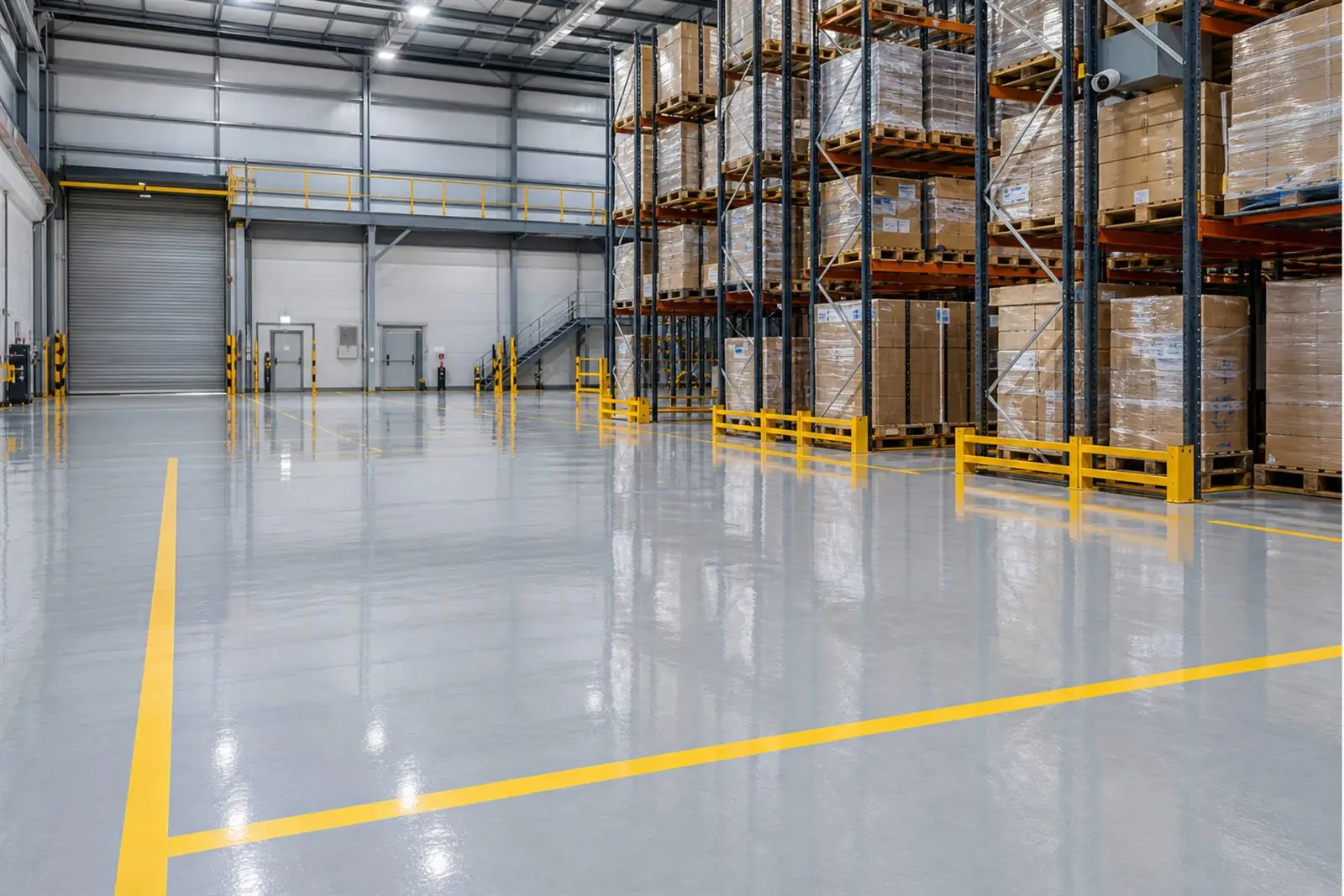
Resin flooring gets specified under a single name when it is really a family of systems. Ask for a resin floor and you could end up with epoxy, polyurethane, or a build-up of both, and the difference between them decides whether your floor lasts a decade or starts failing inside a year. The two are not interchangeable. Here is how we think about choosing between them for commercial sites across London.
What resin flooring actually is
Resin flooring is a liquid-applied system that cures into a seamless, hard-wearing surface bonded directly to the substrate beneath it. Because it is poured and trowelled rather than laid in sheets or tiles, there are no joints for dirt, water or bacteria to get into, which is why it is the default for warehouses, factories, kitchens and labs.
All resin floors share that seamless, bonded character. Where they differ is in the chemistry, and that chemistry decides how the floor copes with chemicals, heat, impact and sunlight. The two workhorses are epoxy and polyurethane, often shortened to PU.
Epoxy: hard, chemical-resistant and cost-effective
Epoxy cures to a very hard, dense surface with excellent adhesion to concrete. That hardness gives it real strengths.
- Chemical resistance is excellent. Epoxy shrugs off oils, solvents, acids and most industrial spills, which is why it is a staple in manufacturing and chemical-handling areas.
- Abrasion resistance under steady wheeled and foot traffic is very good, so it holds up well under forklifts and pallet trucks.
- Cost is usually lower than PU for an equivalent build, which makes it the economical choice across large floor areas.
- Finish can be a high-gloss, easy-to-clean surface that looks sharp in retail back-of-house and showrooms.
That hardness has a flip side. Epoxy is more brittle than PU, so it can crack under sharp impact or where the substrate moves. It is also vulnerable to thermal shock: pour boiling water or steam-clean a standard epoxy floor and the sudden temperature change can cause it to craze or delaminate. And epoxy can yellow and lose its gloss under prolonged UV exposure, so it is not ideal where strong sunlight hits the floor.
Where epoxy earns its place is industrial units, warehouses, production areas, plant rooms and retail back-of-house: dry-ish environments with chemicals and traffic but without big temperature swings or direct sun. If that describes your site, our resin flooring systems are usually epoxy-based for exactly these reasons.
Polyurethane: flexible, tough and temperature-tolerant
Polyurethane trades some of that diamond hardness for flexibility, and that single property changes how the floor behaves.
- Impact and abrasion resistance is excellent. The slight give means PU absorbs knocks that would chip a more brittle epoxy, so it copes with dropped tools and heavy handling.
- Thermal-shock and temperature tolerance is far better. PU systems handle hot liquids, steam cleaning and rapid temperature changes that would damage standard epoxy, and they tolerate both hot and cold environments.
- UV stability is good. PU resists yellowing far better than epoxy, so colours hold up where daylight floods in.
The trade-offs are cost and chemical profile. PU generally costs more than epoxy, and while it stands up well to many substances, epoxy still has the edge against certain aggressive chemicals. So PU is not automatically the better floor; it is the better floor for particular conditions.
Those conditions are commercial kitchens, cold stores, food and drink production, breweries, and any space with temperature extremes, wash-downs or UV exposure. If you are fitting out a kitchen, this is the chemistry you want underfoot.
PU screeds for commercial kitchens
The kitchen case is where PU really pulls ahead. Polyurethane screeds, sometimes called PU concrete or PU cement, are heavy-duty systems laid at greater thickness than a thin coating. They take constant hot spills, boiling water, grease, daily wash-downs and the thermal shock of moving between a hot line and a chilled store, all without breaking down.
A standard epoxy floor in that environment would craze and lift within months. A PU screed, finished with the right safety flooring slip rating, gives you a hygienic, seamless, drainable surface that meets the demands of a busy kitchen. It is the same logic behind our pub flooring work, where back-of-house kitchens and bar areas face exactly these conditions.
Hybrid and build-up systems
You do not always have to choose one or the other. Many commercial floors are built up in layers, using an epoxy primer or body coat for adhesion and chemical resistance with a PU top coat for UV stability and flexibility. This hybrid build gives you the strengths of both: the bond and economy of epoxy lower down, the toughness and colour stability of PU on top. The right build-up depends on the substrate, the traffic and what the floor has to survive, which is why a proper survey matters more than picking a product off a list.
How to choose by environment
The quick way to decide is to rank what your space throws at the floor.
- Chemicals are the main threat, dry conditions, no big heat swings: epoxy, often the most cost-effective option.
- Heat, steam, hot liquids or cold stores: polyurethane, every time.
- Strong daylight or sun on the floor: PU or a PU-topped hybrid for UV stability.
- Sharp impact and heavy handling: PU for its flexibility, or a thicker epoxy build where chemicals dominate.
Most floors are not one pure case, which is where finishes come in. Both systems can be specified with anti-slip aggregates for wet or greasy areas, and with decorative options such as flake or quartz blends for a hard-wearing surface that still looks the part in customer-facing spaces. Even surfaces like gym flooring draw on the same resin principles where a seamless, impact-tolerant base is needed.
Cost and lifespan
Epoxy is generally the lower-priced option upfront, with PU and PU screeds costing more for the extra performance. But the headline price is the wrong number to fix on. A correctly specified resin floor, properly bonded to a sound substrate, lasts many years with minimal upkeep. The expensive floor is the one specified for the wrong environment, because it fails early and has to be stripped and redone.
Common questions
Is polyurethane always better than epoxy? No. PU is better for heat, impact and UV, but epoxy often wins on chemical resistance and cost. The right choice depends on what your space actually does to the floor.
Can I put a resin floor over my existing concrete? Usually, yes, provided the concrete is sound, dry and properly prepared. Preparation is the make-or-break step; we survey the substrate before committing to a system.
Which resin should I use in a commercial kitchen? A polyurethane screed, finished with the right slip rating. It handles the hot spills, wash-downs and temperature swings that would quickly destroy a standard epoxy floor.
If you are weighing up a resin floor for a warehouse, kitchen, unit or retail space in London, we are happy to take a look and recommend the right system rather than the cheapest one. Get a free quote and we will usually come back within 48 hours.