
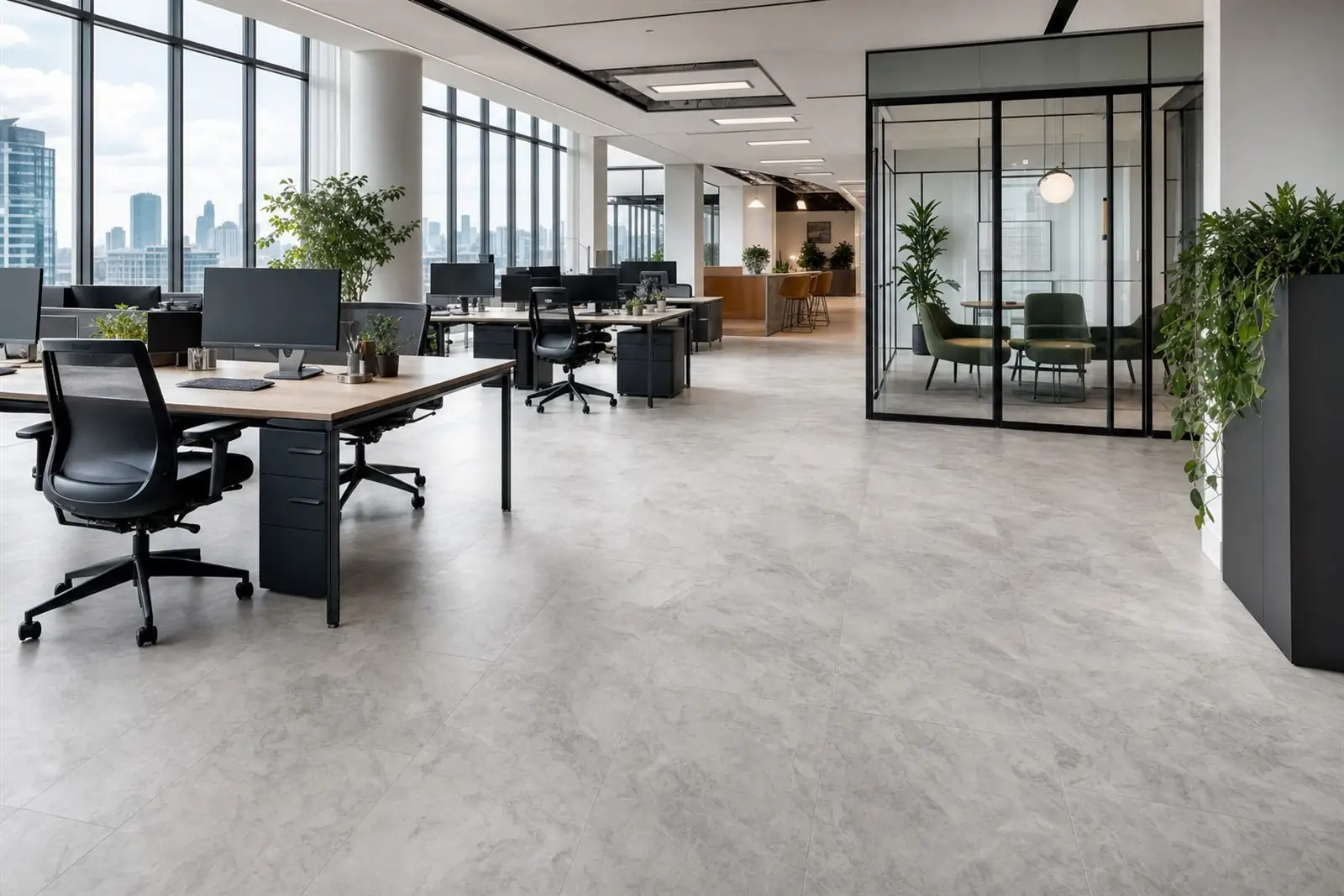
LVT has become the default answer for a huge share of commercial floors, and for good reason: it looks like wood or stone, shrugs off traffic, cleans easily and repairs tile by tile. But “LVT” covers everything from a supermarket own-brand plank to a heavy-commercial product engineered for airport concourses, and the two behave very differently once real traffic hits them. If you are buying the product as well as the installation, the spec sheet matters more than the sample photo. Here is what to actually look for.
Start with the wear layer
The wear layer is the clear coating over the printed design, and it is the single biggest difference between LVT that lasts and LVT that does not. It is measured in millimetres, and the number tells you almost everything about where the product belongs.
- 0.3mm is a residential spec. It has no place in a commercial building, whatever the brochure says about “multi-use”.
- 0.55mm is the standard commercial spec, and the right starting point for offices, retail, hospitality and most public buildings.
- 0.7mm is heavy commercial, worth the step up for entrances off the street, busy corridors, and retail with trolley or constant footfall.
Alongside the wear layer, look for the usage class under EN ISO 10874. Class 33 is heavy commercial and is what we specify for most London commercial work. Class 31 or 32 products are cheaper for a reason, and the saving disappears the first time a high-traffic run wears through early.
Glue-down, click or loose lay
The same design is often available in three formats, and the format decision matters as much as the product itself.
Glue-down (dryback) is the thinnest, most stable and most traffic-tolerant format, and it is what we fit for most commercial jobs. Because every tile is bonded, it copes with heavy rolling loads, point loads from furniture, and tight doorway thresholds. The trade-off is that it demands proper subfloor preparation, which is where much of the labour on an LVT job actually goes.
Click and rigid-core (SPC) planks float over an underlay and lock together at the edges. They go down faster and are more forgiving over an imperfect subfloor, which makes them attractive for refurbishments on a tight programme. The trade-offs are extra build-up height at doors and transitions, and less tolerance of very heavy rolling traffic than a bonded floor.
Loose lay tiles use a heavy, friction-grip backing with minimal or tackifier-only adhesive. They excel where individual tiles need to come up regularly, for example over raised access floors where power and data live underneath.
There is no universally correct answer here. A bonded floor is the right call for a busy restaurant; a click floor can be exactly right for a fast office refit over a tired but sound subfloor.
Design and format choices
This is the enjoyable part, but a few practical points are worth knowing before you fall in love with a sample.
Planks give you wood looks, tiles give you stone and concrete looks, and most commercial ranges offer both in several sizes. Laying patterns change the price as well as the look: herringbone and chevron use more material and more labour than a straight lay, so decide the pattern before the quote, not after it. Borders and tonal zoning are a genuinely useful trick in open-plan spaces, using the floor itself to mark walkways, breakout areas and desking zones without a single partition.
On finish, embossed and textured surfaces hide scuffs and cleaning marks far better than smooth gloss, and a matt finish photographs and wears better in real buildings than it does in a showroom.
Acoustic backing is worth asking about
Standard LVT is a hard floor, and in offices, hotels and multi-storey buildings the sound of footsteps travelling to the floor below is a real complaint. Acoustic-backed LVT builds a resilient layer into the product to cut impact sound, and specifying it at the start costs far less than dealing with a noise problem after handover. If the floor is going over a raised access floor or into upper-storey rooms above quiet space, ask the question early.
The subfloor is half the job
Every LVT floor is only as good as what is underneath it. The tiles are thin, so any lump, ridge or trowel mark in the subfloor telegraphs straight through to the surface. A proper commercial installation includes moisture testing before anything is laid, a smoothing compound to bring the base up to standard, and a damp-proof membrane where readings demand it. If you are comparing quotes and one is much cheaper, missing subfloor preparation is the most common reason. It is also the item you will regret cutting.
Where LVT is the wrong answer
Honest guidance means saying where not to use it. Commercial kitchens, plant rooms and constantly wet areas need safety flooring with aggregate through the wear layer, not standard LVT. Heavy industrial spaces with forklift traffic or chemical spills are resin territory. And where a client wants genuine timber underfoot and the budget allows it, engineered wood remains the premium answer. LVT is superb at what it does; it does not need to pretend to be everything.
Common questions
Is expensive branded LVT worth it over a budget range? Judge the spec, not the brand. A 0.55mm wear layer and class 33 rating from a reputable manufacturer is the benchmark; some premium ranges add better embossing, larger formats and longer warranties, which can be worth paying for in front-of-house spaces. A budget product with a 0.3mm wear layer is not a saving in a commercial building, whoever makes it.
Can LVT go over underfloor heating? Most commercial LVT is compatible with underfloor heating within the manufacturer’s stated temperature limits, typically around 27 degrees at the floor surface. It needs confirming against the specific product datasheet before ordering, which is part of what we check when we quote.
How long does commercial LVT actually last? A properly specified and properly installed class 33 floor is normally warranted for well over a decade of commercial use, and individual damaged tiles can be swapped along the way rather than replacing the floor. The failures we get called to are almost always specification or subfloor problems, not the product itself.
If you are weighing up LVT for an office, shop, pub or public building in London, we supply and fit commercial-grade LVT as one managed job, and we are happy to sense-check a spec you have been given elsewhere. Get a free quote and we will usually come back within 48 hours.