
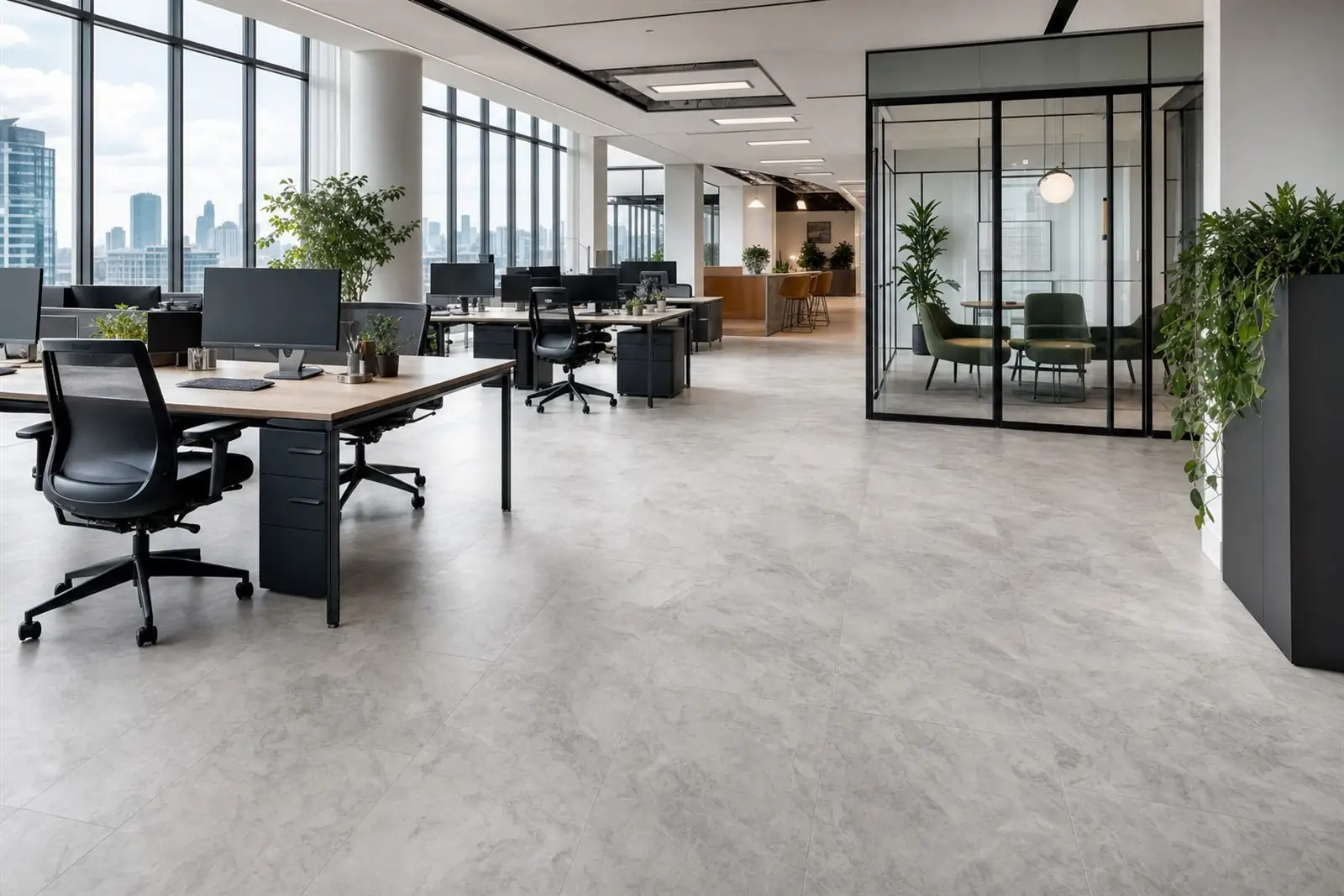
LVT, sheet vinyl and safety flooring all get lumped together as “vinyl”, and the terms get muddled more than almost any other product we quote on. They are related, but they are not interchangeable, and specifying the wrong one is an expensive way to find out. Here is a clear, practical breakdown of what each one actually is, where it belongs, and how to pick the right one for your space.
What each one actually is
The confusion is understandable, because all three are vinyl-based and all three are hard-wearing. The difference is in the format and what the surface is built to do.
- LVT (luxury vinyl tile or plank) comes as individual tiles or planks with a printed design layer and a clear, hard-wearing wear layer on top. The print is what makes it special: realistic wood grain, stone and concrete effects that are hard to tell from the real thing. Planks and tiles are either glued down or clicked together, and because the floor is made of separate pieces, a single damaged tile can be lifted and swapped without touching the rest.
- Sheet vinyl is laid in large rolls rather than individual pieces, with the seams heat-welded together. That gives you a near-seamless, impervious floor with very few joints for water or dirt to get into, which makes it extremely hygienic and easy to clean.
- Safety flooring is a type of sheet vinyl with aggregate, usually grit such as quartz or carborundum, built through the wear layer. Those particles give it sustained slip resistance that lasts the life of the floor rather than wearing off, which is why it is the go-to for wet and high-risk areas.
So LVT is about looks and repairability, sheet vinyl is about hygiene and seamlessness, and safety flooring is sheet vinyl engineered specifically for grip.
The key differences that matter
When you put them side by side, a handful of distinctions drive almost every decision.
Joints and hygiene. LVT has joints between every tile or plank, which is fine for most commercial settings but means more edges than a welded floor. Sheet vinyl and safety flooring are welded into a continuous surface, and in wet areas the vinyl can be coved up the wall to form a sealed, impervious skirting. For anywhere that needs to be wiped down to a clinical standard, the seamless option wins.
Slip resistance. Standard LVT and smooth sheet vinyl are fine underfoot in dry conditions, but they are not designed for wet floors. Safety flooring is, and it holds that grip for years because the aggregate runs through the wear layer rather than sitting on the surface.
Look and design. This is where LVT pulls ahead. Sheet and safety vinyl come in plenty of colours and patterns, but nothing matches LVT for convincing wood and stone effects. If the floor needs to look premium in a reception, showroom or retail space, LVT is usually the answer.
Repairability. Damage a plank of LVT and you replace that plank. Damage a sheet floor and the repair is a patch and re-weld, which is more involved. For spaces where the odd knock is likely, the tile-by-tile fix is a genuine advantage.
Cost. All three sit in a sensible commercial range, and the price depends far more on grade, wear-layer thickness and subfloor preparation than on the category alone. As a rough rule, quality LVT tends to sit at the higher end on material, sheet vinyl is competitive across large areas, and safety flooring carries a small premium for its slip performance. Fitting LVT can also take longer because each piece is laid individually.
Which should you choose
The honest answer is that the setting decides it for you. Match the floor to the room and the rest follows.
- Offices, retail and hospitality: LVT. You want the look, you want the warmth underfoot, and you want to be able to swap a damaged plank rather than re-do a whole bay. Wood and stone effects lift a reception or shop floor in a way smooth vinyl cannot.
- Healthcare and education, non-wet clinical areas: sheet vinyl. Corridors, wards, classrooms and treatment rooms need a seamless, impervious floor that mops clean and gives infection control nothing to catch on. This is the default for a reason, and it is exactly what we specify across healthcare settings.
- Wet rooms, kitchens and changing areas: safety flooring. Commercial kitchens, washrooms, changing rooms, poolside and clinical wet areas all need sustained grip when the floor is wet. This is where safety flooring earns its keep, and it is not worth compromising on.
Plenty of buildings need more than one. A school might run sheet vinyl through the classrooms, safety flooring in the kitchen and toilets, and LVT in the entrance and library. There is nothing wrong with mixing them, as long as each space gets the surface its use demands.
Getting the specification right
Whichever category you land on, the detail underneath matters as much as the product on top. The wear-layer thickness has to suit the footfall, the subfloor has to be sound, level and dry, and welded floors need clean, properly heat-sealed seams to deliver the hygiene you are paying for. A premium floor laid over a poor base or finished with sloppy welds will not last, and that is true across all three. We survey the substrate, prepare or level it where needed, and match the grade to how the room is actually used rather than to a brochure name.
Common questions
Is LVT waterproof? The vinyl itself does not absorb water, but a glued or clicked LVT floor has joints between the planks, so it is not the same as a welded, sealed floor. For genuinely wet areas you want sheet vinyl or safety flooring, where the seams are heat-welded and the vinyl can be coved up the wall.
Is safety flooring just vinyl with a rough surface? Not quite. The slip resistance comes from aggregate built through the wear layer, so the grip lasts as the floor wears rather than rubbing off. It is engineered for wet and high-risk areas, which is why it is specified for kitchens, changing rooms and clinical wet spaces.
Can I use LVT in a busy commercial space? Yes, as long as the wear layer is graded for it. Commercial LVT is hard-wearing and copes well with offices, shops and hospitality, and the ability to replace individual tiles is a real plus in a high-traffic room.
If you are weighing up LVT, sheet vinyl or safety flooring for a project in London, we are happy to help you specify the right one room by room. Get a free quote and we will usually come back within 48 hours.