
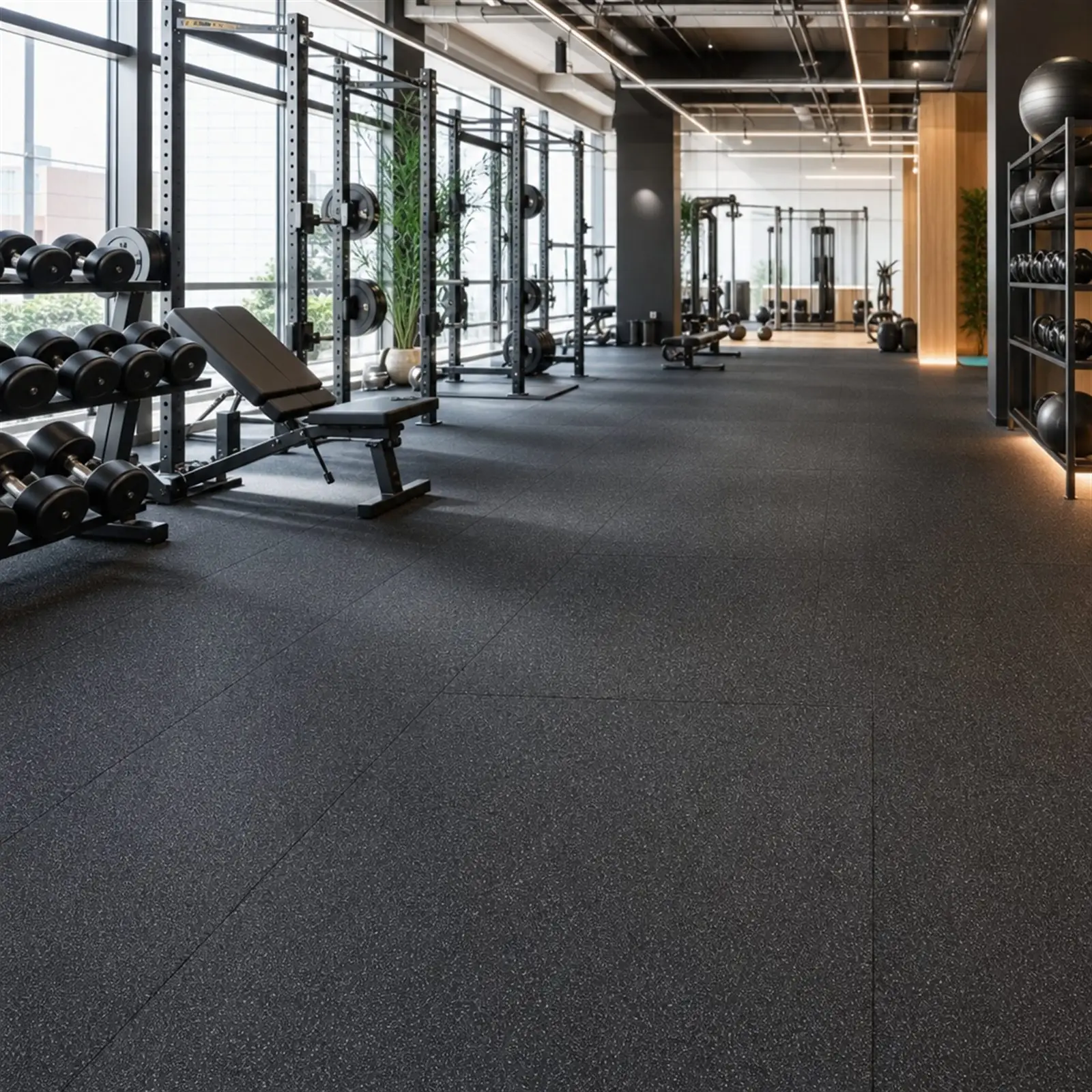
A gym floor takes more punishment than almost any other commercial surface. Loaded barbells get dropped on it, treadmills pound it for hours, and it has to stay grippy when it is covered in chalk and sweat. Get it wrong and you are looking at cracked tiles, complaints about noise from the unit next door, and a slip risk you do not want on your hands. This guide covers how we specify commercial gym flooring for London sites, zone by zone, from boutique studios to full health clubs.
Zone the floor before you price it
The biggest mistake in gym flooring is treating the room as one space with one surface. A good fit-out maps what actually happens in each area and matches the floor to it.
- Free-weights and drop zones take the most abuse: loaded bars coming down from hip and shoulder height, dumbbells rolling off benches, plates stacked and dragged. This is where the thickest, densest rubber goes.
- Rigs and racks concentrate enormous point loads through their feet and anchor fixings, and the floor around them takes bar drops too. The surface needs to be dense enough not to deform under the frame while still absorbing impact beside it.
- Functional zones and turf tracks see sled pushes, farmer’s carries, battle ropes and kit dragged in every direction, so they want tear-resistant rubber and, increasingly, a run of artificial turf for sled and prowler work.
- Cardio areas carry static load from treadmills, bikes and rowers rather than repeated impact, so a thinner rubber works well and is easier to keep clean under the machines.
- Studios for classes, spin and yoga want comfort and controlled flex underfoot rather than raw toughness.
- Stretching and mobility areas suit a slightly softer, warmer surface that is comfortable to kneel and lie on.
Zoning is also how the budget behaves. Specify the whole floor to survive the deadlift corner and you overspend everywhere else; specify it all for cardio and the free-weights area is wrecked in months.
Rubber thickness: why drop zones are different
Rubber is the workhorse of gym flooring, and thickness is the single spec decision that matters most. As a working guide, cardio and general circulation areas are usually fine on rubber around 6 to 8mm. General strength areas, where weights are lowered rather than dropped, typically want 15 to 20mm. Dedicated drop zones, where bars come down from height under Olympic lifts, need 30mm and upwards of dense rubber, or a built-up lifting platform.
The reason drop zones differ is simple physics. A bar lowered to the floor transfers its energy gradually; a bar dropped from overhead arrives all at once, and something has to absorb that energy. Thin rubber passes it straight through to the slab, which is how subfloors crack, tiles split and downstairs neighbours end up on the phone. Thick, dense rubber deforms momentarily under the impact and spreads the load, protecting the bar, the slab and the structure in one go.
Format matters alongside thickness. Interlocking tiles are quick to fit and easy to swap if one gets damaged. Sheet or roll rubber gives fewer joints across a big floor, which looks cleaner and leaves fewer edges for moisture to creep into. Poured rubber crumb creates a seamless bonded surface for heavy-duty performance areas. We match format and thickness to how members actually train, not to the brochure name.
Acoustics and vibration: the London problem
In much of London, the gym is not a standalone building. It sits under flats, over offices, or wall-to-wall with retail in a mixed-use block, and structure-borne noise is the complaint that actually threatens a gym’s lease. Airborne noise from music is one problem; the thud of a dropped bar travelling through the frame of the building is another entirely, and ordinary rubber alone will not stop it.
Where a gym sits above or beside other tenants, the floor needs to be designed as an acoustic build-up, not just a surface. That can mean acoustic underlays beneath the rubber, isolating layers under lifting platforms, and thicker rubber in drop zones than impact protection alone would call for. It is far cheaper to design this in at fit-out than to retrofit it after the complaints, and if the landlord or an acoustic consultant has set noise conditions, the floor build-up is where most of the compliance happens. We would rather talk about this at survey stage than after your neighbours do.
Studio floors: sprung or point-elastic
Studios are their own specification. The two main families are area-elastic sprung floors, where a timber or composite build-up flexes over a wider area underfoot, and point-elastic surfaces, usually cushioned vinyl, which deform only at the point of contact.
Sprung floors suit dance, high-impact classes and anything with repeated jumping, because the whole floor returns energy and takes strain off knees and ankles. Point-elastic surfaces suit multi-purpose studios that host everything from spin to pilates, they are easier to clean, and they cope better with equipment being moved about. Many London studios land on a point-elastic sports vinyl for versatility, with sprung floors reserved for dedicated dance and group-exercise spaces. Our sports flooring page covers both families in more detail.
Turf runs and sled tracks
Artificial turf tracks have become a fixture in functional zones, and for good reason: turf takes sled and prowler work that would shred rubber, marks out the zone visually, and gives members a surface for drills that concrete-hard floors cannot offer. The details that matter are pile height and density suited to sled runners, a proper bonded or contained installation so the edge does not lift into a trip hazard, and a clean junction with the surrounding rubber. A turf run laid loose over rubber is a maintenance problem waiting to happen.
The subfloor does half the work
Rubber is only ever as good as what it sits on. Before anything is laid we check the substrate is sound, level and dry, and prepare or level it where it is not. On upper floors this matters twice over, because the slab also has to carry the combined weight of the flooring build-up, the rigs and the loaded bars. Laying premium rubber over a cracked, damp or uneven base is money wasted, and it voids most manufacturer warranties too.
Hygiene, cleaning and grip
Sweat, chalk and cleaning chemicals are the daily reality of a gym floor. The specification has to survive the cleaning regime as well as the training: sealed or low-porosity rubber that machine-scrubs without breaking down, surfaces that tolerate the disinfectants your cleaners actually use, and a finish that stays grippy when damp. Slip resistance is measured and specified rather than guessed, and our guide to slip resistance and R ratings explains the ratings that appear on datasheets. Changing rooms, wet areas and poolside are a separate specification again, covered on our safety flooring page, and a proper entrance matting system stops grit and rain being walked from the street straight onto the training floor.
Fitted without closing the gym
A gym losing floor space is a gym losing members, so installation is planned around trading. We fit overnight and in phases wherever we can, zoning the work so the rest of the floor stays open while one area is refitted, and handing each zone back ready for the morning rush. From a single free-weights area to a full multi-zone fit-out, it is one managed job with one accountable price and one point of contact from survey to handover. Our dedicated gym flooring page covers the full service.
Common questions
How thick should gym rubber flooring be?
It depends on the zone. Cardio and circulation areas are usually fine around 6 to 8mm, general strength areas typically want 15 to 20mm, and dedicated drop zones need 30mm and upwards of dense rubber or a built-up lifting platform. Specifying one thickness for the whole gym almost always means overpaying in some zones and under-protecting others.
Our gym is above other tenants. Can flooring really control the noise?
It can do a great deal, but only if it is designed as an acoustic build-up rather than a single layer. Thick rubber, acoustic underlays and isolated lifting platforms together take most of the energy out of a bar drop before it reaches the structure. What matters is dealing with it at fit-out stage, because retrofitting acoustics after complaints is disruptive and expensive.
What is the difference between sprung and point-elastic studio floors?
A sprung floor flexes over a wide area and returns energy to the whole body, which suits dance and high-impact classes. A point-elastic floor, usually a cushioned sports vinyl, gives at the point of contact only, which suits multi-purpose studios and is easier to clean and maintain. Most mixed-use London studios choose point-elastic; dedicated dance spaces justify sprung.
Do we need to close while the floor is fitted?
Usually not. We plan installations in zones and work overnight or around your timetable, so one area is refitted while the rest keeps trading. A full fit-out is phased the same way, with each zone handed back finished before the next is started.