
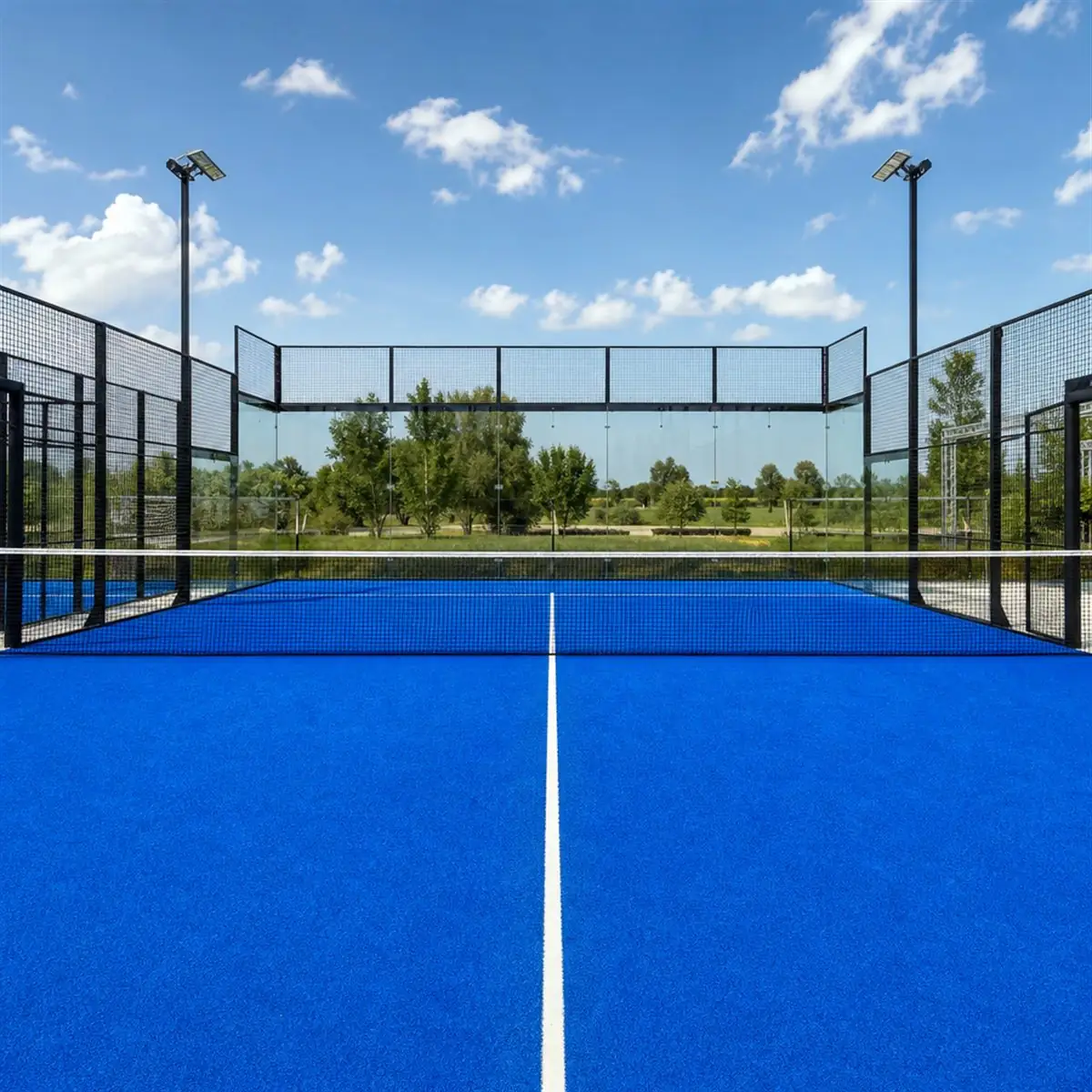
Walk into almost any new padel club and look up. Above or beside the courts there is usually a mezzanine: a viewing gallery, a cafe and bar deck, a warm-up gym, sometimes a small office for the club team. Court space is expensive and the social side is where members linger and spend, so the raised level has to earn its keep.
The mezzanine structure itself, the steel, the decking, the staircase, comes from a mezzanine supplier and a structural engineer. What we do is the layer people actually walk on. This guide covers choosing and fitting the floor finishes on a padel club mezzanine so the level looks right, wears well and does not rain footfall noise down on the courts below. It sits alongside our guide to the courts themselves, which covers turf, infill and base build.
Start with what the deck can carry
Every mezzanine is designed to a loading, and every finish, underlay and build-up adds weight to it. Most of the finishes that make sense on a club mezzanine, carpet tile, LVT, rubber and safety flooring, are relatively light per square metre, but gym zones deserve particular care: thick rubber tiles, rack lines and free-weight areas concentrate load in ways the original deck design may not have anticipated.
So before any finish is specified, the question goes to your mezzanine supplier or structural engineer: what is the deck rated for, and does the intended use plus the flooring build-up sit comfortably inside it? That is their call, not ours, and we will not fit a gym floor on a deck nobody has checked. What we can do is keep the build-up light where the structure is tight, and coordinate the finish spec with whoever designed the deck. The same conversation should settle the subfloor, because chipboard or cement particle decking usually needs a smoothing or ply layer before a glued finish like LVT will sit flat.
Acoustics: the mezzanine’s real design problem
On a ground-bearing slab, footsteps go nowhere. On a mezzanine above or beside play, every heel strike, dragged chair and dropped dumbbell travels through the deck into the space below, and padel players notice. It is far cheaper to design the noise out in the flooring spec than to retrofit it after complaints.
The tools, in rough order of effect:
- Carpet tile is the quietest finish going and the natural choice for viewing galleries and lounge seating. It soaks up impact noise at the source and softens the general acoustics of a big, hard-surfaced hall at the same time.
- Acoustic underlays go beneath LVT and other resilient finishes to cut the impact sound transmitted through the deck. On a mezzanine over play, an acoustic underlay under LVT should be the default, not an upgrade.
- Rubber flooring is inherently resilient, which is why it belongs in gym and warm-up zones: it absorbs the impact of feet and weights rather than passing it into the structure.
- Layout helps too. Put the loudest uses, gym zones and busy routes, over circulation or storage rather than directly over a court where the plan allows.
Choosing finishes zone by zone
A padel mezzanine is really several rooms sharing one deck, and the flooring should change with the job.
Viewing galleries and lounges want comfort and quiet. Carpet tile is the workhorse: soft underfoot, forgiving of spills in a soil-hiding design, and replaceable tile by tile when the front-row line wears. The harder-wearing alternative is LVT on an acoustic underlay, and the two combine well, carpet in the seating and LVT on the walkways.
Cafe and bar decks live with spills, chair scrapes and constant traffic between counter and tables. LVT is usually right: it wipes clean, takes furniture well and comes in wood and stone looks that make the space feel like a destination rather than a landing. Behind the counter, where staff work on wet, greasy floors, safety flooring with proper slip resistance is the better answer, as in any commercial servery.
Gym and warm-up zones need rubber. It protects the deck from dropped weights, gives the right firmness for stretching and strength work, and quietens the zone into the bargain. Tile formats are practical on a mezzanine because they go up the stairs in manageable pieces, and thickness is a balance between protection, acoustics and weight, which is why the structural conversation comes first. Our gym flooring page covers the options in depth.
Offices and back rooms are straightforward: carpet tile for quiet, or LVT to match the rest of the level.
Stairs, edges and visibility
The staircase is the hardest-working flooring in the club after the courts, and it is where mistakes hurt. Every step needs a proper stair nosing: a purpose-made edge profile that protects the step, gives grip and marks the edge. Building guidance expects nosings to contrast visually with the tread so each step reads clearly, which matters in a hall lit for play rather than for stairs, climbed by people carrying rackets, kit bags and drinks.
On open edges and landings, run the finish tight to the balustrade with proper trims, and keep the finish consistent across the landing so there is no surprise change in grip at the top of a flight. Players arrive on the stairs with sandy soles, so safety flooring or dedicated stair tread material is a sensible spec for the flight itself.
Keeping it clean
Padel brings a specific housekeeping problem upstairs: silica sand. The infill that makes the courts play properly migrates on shoes, and on a mezzanine it becomes grit that grinds at every finish it lands on. Barrier matting at the top of the stairs or at court-side doorways strips most of it before it spreads. Beyond that the routine is ordinary: vacuum carpet tile, damp mop LVT and safety floors, and clean rubber with a product the manufacturer approves. Choose tile formats where you can, because single damaged tiles swap out without closing the cafe.
One level, one accountable job
We supply and fit the complete finishes package for padel mezzanines, carpet tile, LVT, rubber, safety flooring, nosings and trims, as one managed job coordinated with your mezzanine supplier, so the level opens with the courts. If you are planning a new club or adding a mezzanine to an existing one, get a free quote and we will usually come back within 48 hours. For the playing surface itself, see our padel court surfacing service, and for the material options, our LVT flooring page.
Common questions
Do you build the mezzanine itself?
No. The structural deck, steelwork and staircase come from a mezzanine floor supplier, designed and signed off by a structural engineer. We supply and fit the finishes that go on top: carpet tile, LVT, rubber, safety flooring, underlays, nosings and trims, and we are happy to coordinate directly with your mezzanine supplier.
What is the best flooring for a padel viewing gallery?
Carpet tile, in most clubs. It is the quietest finish over play, comfortable for spectators who stand and sit for long spells, and individual tiles replace easily when the front row wears. Where you want a harder-wearing look, LVT on an acoustic underlay is the alternative, and many clubs combine the two.
How do we stop mezzanine noise disturbing play below?
Specify it out in the finishes: carpet tile in seating areas, acoustic underlay beneath any LVT, rubber in gym zones, and the noisiest uses positioned away from directly above the courts where the layout allows. Retrofitting acoustics after complaints is far more disruptive than building them into the original spec.
Can we put a gym on a padel club mezzanine?
Often, but the deck loading comes first. Ask your mezzanine supplier or structural engineer to confirm the deck is rated for gym use, including concentrated loads from racks and free weights. Once that is confirmed, rubber flooring in an appropriate thickness protects the deck, quietens the zone and gives the right surface for training.