
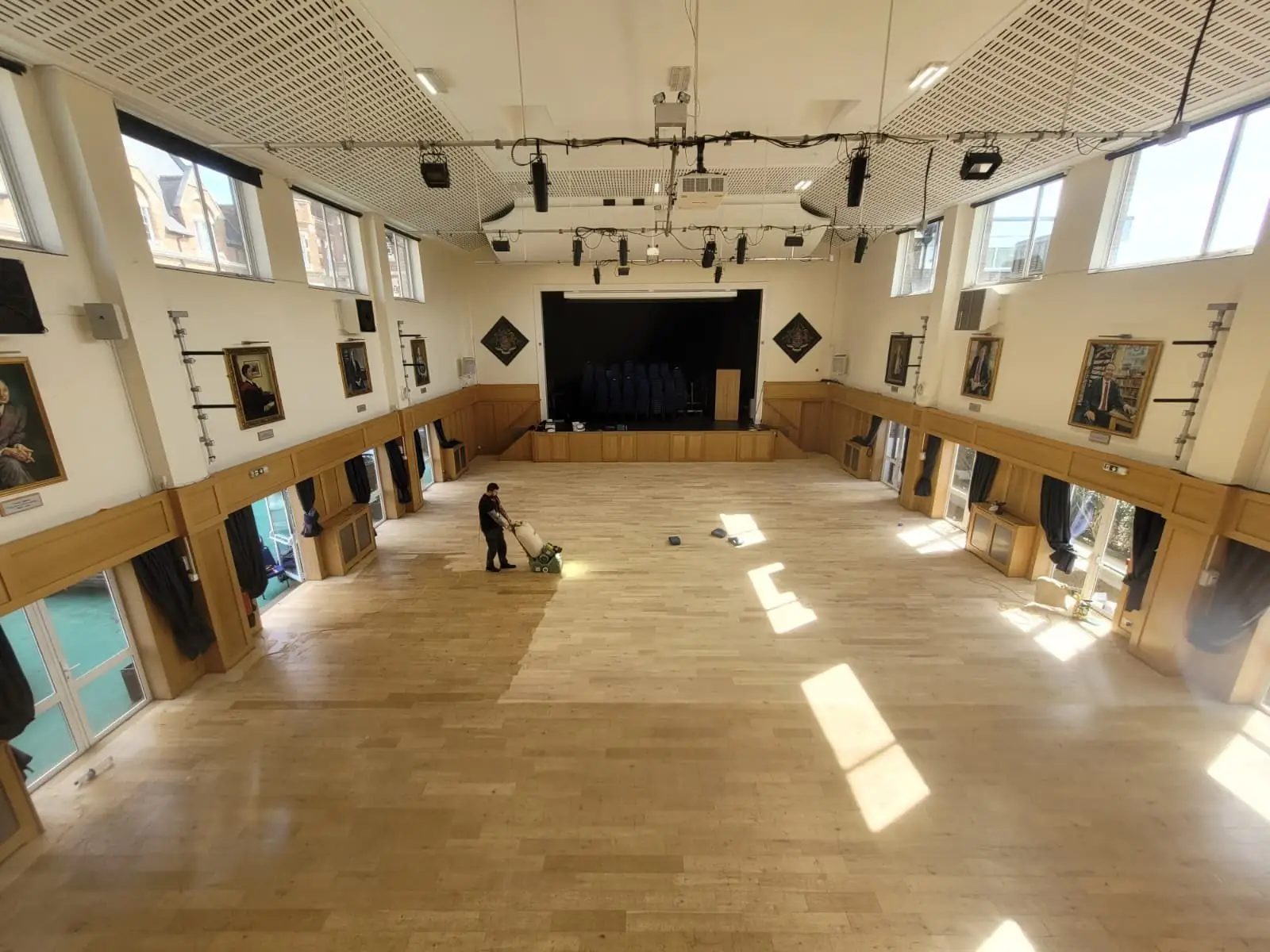
It is the first question almost everyone asks, and the honest answer is that there is no single number. Commercial floor sanding is priced on the job in front of us, not off a list, because two floors of the same size can need very different amounts of work. A tired but sound office floor is a world away from a school hall with cupping boards, old fixings and three layers of failed lacquer. What we can do is be clear about what drives the price, so you can read a quote properly and compare like for like.
What actually affects the cost
A handful of factors do most of the work in setting the price.
- Area in square metres. This is the headline driver. Sanding is usually priced per square metre, so a bigger floor costs more in total, though the rate per square metre often eases on larger, open areas where the machines can run uninterrupted.
- Floor type. Solid hardwood, engineered board, parquet blocks and softwood pine all behave differently under the machine. Parquet is slower, more skilled work, because the blocks run in different directions and the herringbone or basketweave pattern has to be sanded carefully to avoid scratching across the grain. Engineered boards have a thin real-wood wear layer, so there is a limit to how much can be taken off.
- Current condition. A floor that just needs freshening up is quick. One with deep scratches, paint, adhesive residue, old finishes, water staining or movement between boards needs more passes and more preparation.
- Number of coats. More coats mean more material and more time, with drying between each. A heavy-traffic commercial floor usually wants more build than a lightly used one.
- Finish type. The choice between a lacquer and a hardwax oil changes both the look and the labour. Quality systems from names such as Bona and Osmo behave differently to apply and cure, and a durable commercial-grade finish is a different spec to a basic domestic one.
- Gap filling and repairs. Filling the gaps between boards, and fixing loose blocks, split boards, missing pieces and squeaks, is extra work that is often quoted as a separate line and varies hugely from floor to floor.
- Access and parking. Upper floors with no lift, tight stairwells, restricted delivery windows and London parking or congestion charges all add to the cost of getting the team and kit on site.
- Out-of-hours and overnight working. If the floor has to be done while the premises are closed, evenings, weekends or overnight, that is reflected in the price.
- Dust-free extraction. Continuous extraction that keeps dust down is standard on a proper commercial job and part of doing it cleanly in an occupied building.
When you see two very different quotes, the gap is almost always hiding in this list, usually in the preparation, the number of coats or the quality of the finish.
How commercial floor-sanding pricing is usually structured
Most commercial floor sanding is quoted per square metre, covering the sanding and an agreed finish specification. On top of that you will often see a minimum charge for smaller floors, because getting the team, machines and materials to site costs much the same whatever the area. Extras such as gap filling, repairs, removing an old finish or a higher coat count tend to be shown as separate lines, so you can see what you are paying for. Some jobs are priced from a measured survey of the actual area and condition; others on a day rate where the scope is harder to pin down up front.
We always prefer to survey before quoting where we can. Floors hide their problems until the first pass takes the top off, so a quote built on a proper look is far more likely to hold than a number plucked over the phone. Rates vary across the market and depend on every factor above, so be wary of anyone who gives you a firm price without seeing the floor.
Why the cheapest quote is rarely the best value
It is tempting to take the lowest number, but floor sanding is one of those trades where the cheap quote often costs more in the end. A rock-bottom price usually means corners somewhere: fewer coats, a thinner or cheaper finish, no gap filling, skipped repairs, or rushed preparation. You will not see it on day one. You see it six months later when the finish wears through in the traffic lanes, the gaps gather grime, or a loose board works free.
A floor finished properly gives you years of service before it needs anything more than a maintenance coat. A floor done on the cheap can be back to bare patches within a season, and re-sanding removes more timber each time, which matters most on engineered boards and old parquet where there is only so much wear layer to go round. The right question is not who is cheapest, but who is giving you a floor that lasts.
How to compare quotes fairly
To compare quotes properly, make sure they are pricing the same thing.
- Match the spec. Same number of coats, the same grade and type of finish, the same approach to gap filling and repairs. Three coats of a commercial lacquer and two coats of a basic finish are not comparable.
- Check what is included. Does the price cover masking, dust extraction, edge sanding into corners and a final clean, or are those extras?
- Look at preparation. Removing old finishes, adhesive or paint is real work, and a quote that ignores it has either not seen the floor or is planning to skip it.
- Confirm timings. Drying and curing times, and whether the work is daytime or out of hours, affect both price and how long your space is out of action.
Once everything is on the same basis, the cheapest quote often turns out not to be the cheapest at all.
How to get an accurate price
The most reliable way to price a commercial floor is to let us see it. A short survey tells us the floor type, its condition, the area, the access and the finish you want, and from there we can give you a clear, itemised quote with no surprises once the machines start. We will talk you through the options, from a straightforward sand and seal to full floor sanding and wood floor restoration, and be honest about what your floor needs. If you have parquet flooring or another older wood flooring you are not sure can be saved, that is exactly the kind of floor a proper survey is for.
Common questions
Can you sand floors while we stay open? Often, yes. We zone the work and run it out of hours or overnight where needed, with continuous dust extraction, so you can keep trading while one area is done at a time. The plan depends on your floor, your finish and your opening hours.
How often will a commercial floor need re-sanding? A properly sanded and finished floor should last for years, with a maintenance coat rather than a full re-sand keeping it going. Solid timber can take many sandings over its life, while engineered boards and thin parquet have a more limited wear layer, which is one more reason to get the job done well the first time.
Why do quotes vary so much? Because floors vary so much. Differences in condition, coats, finish, gap filling, repairs and access can move the price significantly, and some quotes quietly leave work out. That is why we recommend comparing on a like-for-like spec rather than on the headline number alone.
If you have a timber, parquet or pine floor in London that needs bringing back to life, we are happy to come and take a look. Get a free quote and we will usually come back within 48 hours with a clear, itemised price for the work your floor actually needs.